
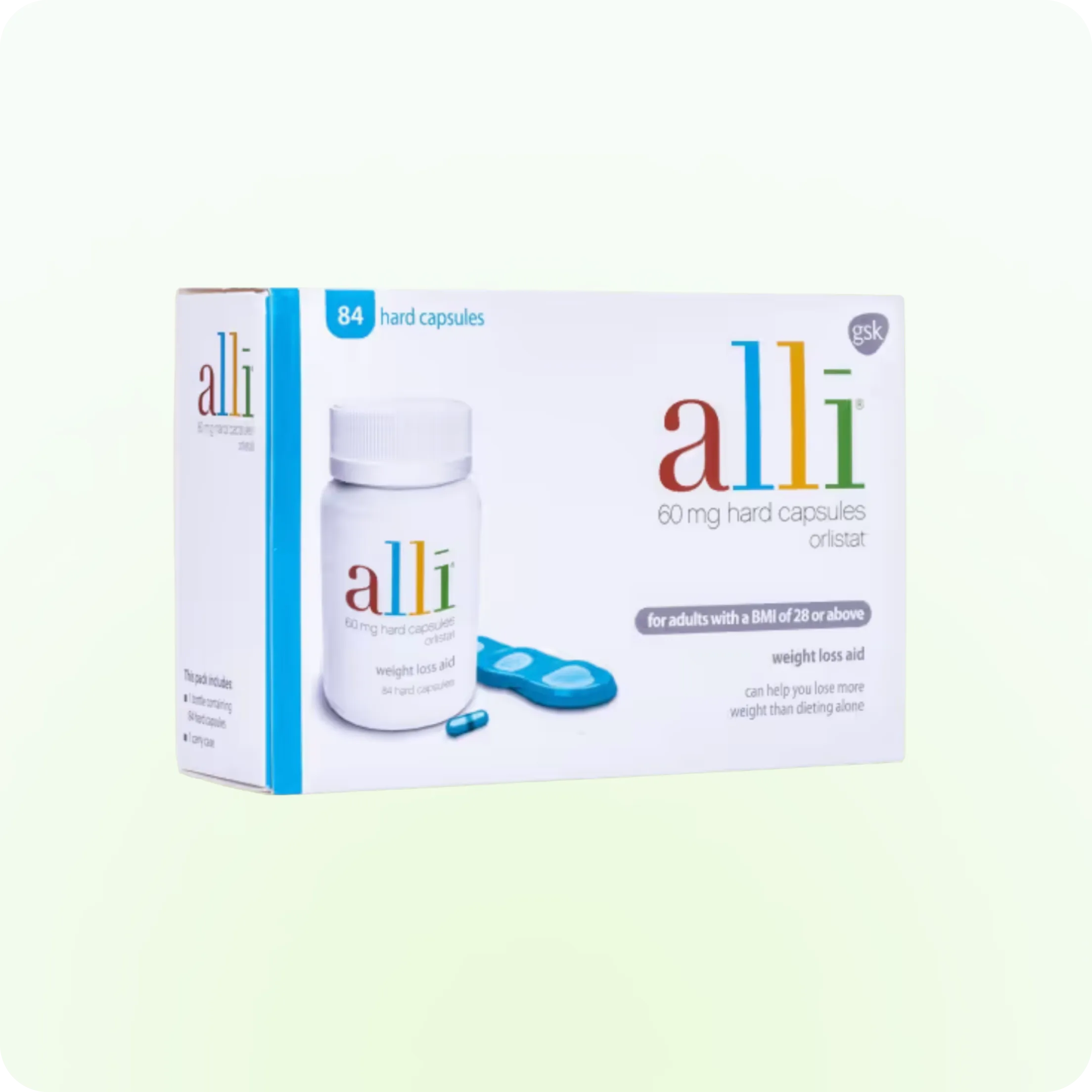
Orlistat
Orlistat can help you lose more weight than diet changes alone by reducing how much fat your body absorbs from meals. It is available in 60mg.
Meet the Alli 60mg capsules
Pack size 84
Suitable for: Weight loss in adults aged 18 and over who are overweight and have a body mass index (BMI) of 28 or above. Alli should be used along with a reduced-calorie, lower-fat diet.
When purchasing this product you will be asked to complete a short online questionnaire to ensure it is safe and appropriate for you. Always read the label and the enclosed information leaflet before taking any medicine for the first time.
Active ingredient: Orlistat 60mg
Other ingredients: Gelatin, Indigo carmine (E132), Iron oxide black (E172), Microcrystalline cellulose (E460), Polysorbate 80, Povidone (E1201) (K-value 30), Propylene glycol, Shellac, Sodium laurilsulfate, Sodium starch glycolate (Type A), Sorbitan monolaurate, Talc, Titanium dioxide (E171).
How it works
Orlistat works in your gut, not on your appetite. It stops some dietary fat from being broken down and absorbed, so that fat passes through your body in your stools. The 60mg strength blocks around 25% of dietary fat*.
Instructions for use:
Take one capsule, 3 times a day.
Take Alli just before, during or up to 1 hour after meals. This usually means 1 capsule at breakfast, lunch and dinner. Make sure your three main meals are well balanced, reduced calorie, and lower-fat.
*Haleon UK Trading Limited. (2023). alli 60 mg hard capsules: Summary of Product Characteristics. (SmPC)
Weight loss by Hers
Partner with clinicians to customise your treatment plan
If eligible, your treatment will be delivered directly to your door with your side effect kit and weight loss starter pack.
Access to unlimited 24/7 clinician support and ongoing check-ins with registered clinicians
Track your progress and access expert led content on nutrition, exercise and more via your Hers App
About Orlistat
Orlistat works differently from treatments that act on your appetite. Here is what to know about the results it can support, how it works and how it compares with other weight loss medicines.
Does orlistat work for weight loss?
Yes. Orlistat can help you lose more weight than making diet and lifestyle changes alone. The honest answer is that it tends to support steady rather than dramatic weight loss. It works by reducing how much fat your body absorbs from meals, rather than suppressing your appetite.
How much you lose will depend on the strength you take and how your body responds. In pooled studies, almost half of people taking 60mg orlistat lost at least 5% of their starting weight after 6 months*. Individual results may vary.
*Haleon UK Trading Limited. (2023). alli 60 mg hard capsules: Summary of Product Characteristics.
How does orlistat work?
Enzymes called lipases help break down the fat in food so your body can absorb it. Orlistat blocks some of these enzymes in your stomach and small intestine. This means some dietary fat is not absorbed and leaves your body in your stools.
Orlistat only works with the fat in the meals you eat. It does not suppress your appetite, so it still needs to be used alongside a reduced calorie, lower fat diet.


Eligibility for Orlistat
Am I eligible for orlistat 60mg capsules?
Alli 60mg is licensed for adults aged 18 and over with a BMI of 28 or higher. You do not need a prescription, but a consultation with a pharmacist is still required before it can be supplied.
Meeting the BMI criterion does not guarantee treatment; your health and any medicines or supplements you take will be taken into account too.
Who should not take orlistat 60mg?
Orlistat 60mg may not be suitable for you if you are under 18, are allergic to orlistat, have chronic malabsorption syndrome, have cholestasis, are pregnant or breastfeeding. People with kidney disease may also need particular medical advice before taking orlistat.
Restrictions for some medications differ by strength:
Important: It must not be taken with ciclosporin, warfarin or another oral anticoagulant.
Tell your Hers clinician about every medication, vitamin and supplement you take. This includes levothyroxine, diabetes medicines, medicines for epilepsy, HIV medicines, amiodarone, acarbose, antidepressants, antipsychotics and benzodiazepines.
This is not a complete list. Read the patient information leaflet supplied with your treatment and ask your clinician if you are unsure.
How to take Orlistat 60mg
Take orlistat with main meals containing fat. Taking the correct strength at the right time helps it work as intended and can reduce avoidable digestive side effects.
How to take orlistat capsules?
Take 1 capsule 3 times a day.
Take Alli just before, during or up to one hour after meals. This usually means one capsule at breakfast, lunch and dinner. Make sure your three main meals are well balanced, reduced calorie, and lower-fat.
What if I miss a dose
If you remember within 1 hour of your meal, take the missed capsule. If more than one hour has passed, skip it and take your next dose with your next main meal containing fat.
Do not take 2 capsules at the same time or take an extra capsule to make up for a missed dose.
How long can I take orlistat?
60mg orlistat should not be taken for longer than 6 months. If you have not lost weight after 12 weeks, speak to your clinician. You may need to stop treatment.


Side effects and warnings
Most orlistat side effects affect digestion because unabsorbed fat passes through your bowel. They are often more noticeable when you first start treatment and after meals that are high in fat.
What are the most common side effects of orlistat?
The most common side effects include:
Oily spotting
Passing gas with an oily discharge
Fatty or oily stools
A sudden or more frequent need to go to the toilet
Soft or liquid stools
Stomach pain or discomfort
Difficulty controlling bowel movements
Eating a balanced, lower fat diet can reduce the chance of these side effects.
Serious side effects
It is not known how frequently these side effects occur.
Severe allergic reactions
Bleeding from the back passage (rectum).
Diverticulitis (inflammation of the large intestine)
Pancreatitis (inflammation of the pancreas).
Skin blistering (including blisters that burst).
Severe stomach pain caused by gallstones.
Hepatitis (inflammation of the liver).
Oxalate nephropathy (build up of calcium oxalate which may lead to kidney stones).
➜ Stop taking the capsules and tell us and your usual doctor if you get any of these.
A full list of all possible side effects can be found in the information leaflet inside the pack
When should I get medical help?
Call 999 if you have signs of a severe allergic reaction, such as difficulty breathing or swelling of your face, lips, tongue or throat.
Call NHS 111 or seek urgent medical advice if you develop severe or persistent stomach or back pain, bleeding from your bottom, yellowing of your skin or eyes, or another side effect that feels serious.
Speak to a pharmacist, clinician or doctor if a side effect is bothering you or does not settle.
Can orlistat affect or interact with other medication, vitamins or contraception?
Orlistat can reduce the absorption of fat-soluble vitamins A, D, E and K. If you're advised to take a multivitamin, take it at least 2 hours after your orlistat dose or at bedtime.
Orlistat can also interact with some medicines. Tell your clinician about everything you take before starting treatment, including medicines, vitamins and supplements bought without a prescription.
Orlistat does not directly affect the contraceptive pill. However, severe diarrhoea can reduce contraceptive protection. If this happens, follow the missed-pill advice for your specific contraception and use an additional barrier method, such as condoms.
Are there differences for women?
Do not use orlistat during pregnancy or while breastfeeding. Tell your clinician if you are pregnant, trying to conceive or breastfeeding.
There is no direct interaction between orlistat and the contraceptive pill, but severe diarrhoea can reduce protection from oral contraception. Use an additional barrier method if this happens.
Frequently Asked
Questions About Orlistat
Here are answers to common questions about accessing orlistat,
using it safely and how it fits with other weight loss treatments.
Can I take orlistat with Wegovy® or Mounjaro®?
No. Do not take orlistat alongside Wegovy®, Mounjaro® or another weight loss medicine unless a specialist has specifically advised it. Hers does not prescribe these treatments together. If you are switching treatments, follow the instructions provided by your clinician.
Is orlistat safe for long term use?
The 60mg non-prescription dose should not be used for longer than 6 months. Your progress should be reviewed after 12 weeks, regardless of the strength you take. Do not continue longer than recommended for your product.
Is orlistat available on the NHS?
Orlistat may be prescribed on the NHS if you meet the relevant criteria. Access depends on your GP or local weight management service. The 60mg strength can also be supplied without a prescription following a consultation with a pharmacist.
What happens when I stop taking orlistat?
Orlistat only changes fat absorption while you are taking it. After you stop, the amount of fat passing through your stools usually returns to its previous level within 48 to 72 hours.
Continuing the eating and activity habits that supported your progress can help you maintain your weight. If you are worried about regaining weight, speak to your Hers clinical team before stopping treatment.
Sources
Haleon UK Trading Limited. alli 60 mg hard capsules: Patient Information Leaflet (PIL). https://www.medicines.org.uk/emc/product/6533/pil
Haleon UK Trading Limited. (2023). alli 60mg hard capsules: Summary of Product Characteristics (SmPC). https://www.medicines.org.uk/emc/product/6533/smpc
National Institute for Health and Care Excellence. (2025). A guide for prescribing medicines to manage overweight and obesity. https://www.nice.org.uk/guidance/ng246/resources/a-guide-for-prescribing-medicines-to-manage-overweight-and-obesity-15299628589
Torgerson JS, et al. (2004). XENical in the prevention of diabetes in obese subjects (XENDOS) study: a randomised study of orlistat as an adjunct to lifestyle changes for the prevention of type 2 diabetes in obese patients. https://pubmed.ncbi.nlm.nih.gov/14693982/

Win some, lose some
Free assessment by a medical clinician through Hers
No in-person visit required
Personalised to your unique needs